Lovesick Blues: from a Cincinnati studio to the Ryman
An older pop song becomes a Hank Williams signature through a Cincinnati recording and a celebrated Nashville performance.
Lovesick Blues was already an older song when Hank Williams made it his own as a performer. Its rise connects the live response he encountered in Shreveport, a recording session at Herzog in Cincinnati, and his Grand Ole Opry debut at Nashville’s Ryman Auditorium. The studio and the Ryman are two distinct physical anchors in that history. Williams’s interpretation, rather than authorship of the song, is the thread between them.
Explore the places
Markers identify buildings or documented location references. They do not mark an exact recording room, stage position or camera angle.
The Country Music Hall of Fame and Museum traces Lovesick Blues to a pop song from 1922. Its account places Williams on the Louisiana Hayride in Shreveport after he moved there in August 1948. He began performing the song, and the audience response encouraged him to record it. The museum identifies either a Rex Griffin or an Emmett Miller recording as his source. That uncertainty remains part of the account; choosing one would make the evidence more definite than it is.[2]
The record is made in Cincinnati
Herzog Music’s anniversary history dates Williams’s Lovesick Blues recording to 22 December 1948, one of four songs he recorded there that day. It identifies the historic studio at 811 Race Street in downtown Cincinnati. The record’s making belongs to that named studio. The later Nashville breakthrough does not move the recording session to the Opry’s city. Herzog’s separate August 1949 session included I’m So Lonesome I Could Cry, keeping the two visits distinct.[1]
Success opens the Opry door
The museum records the song reaching number one in May 1949 and remaining there for sixteen weeks. It links the success of Lovesick Blues and the follow-up Wedding Bells to the Opry’s decision to hire Williams. Both were interpretations of songs he had not written. His growing reputation as a songwriter and his ability to transform older material belong together in this part of the story.[2]
The Ryman audience calls him back
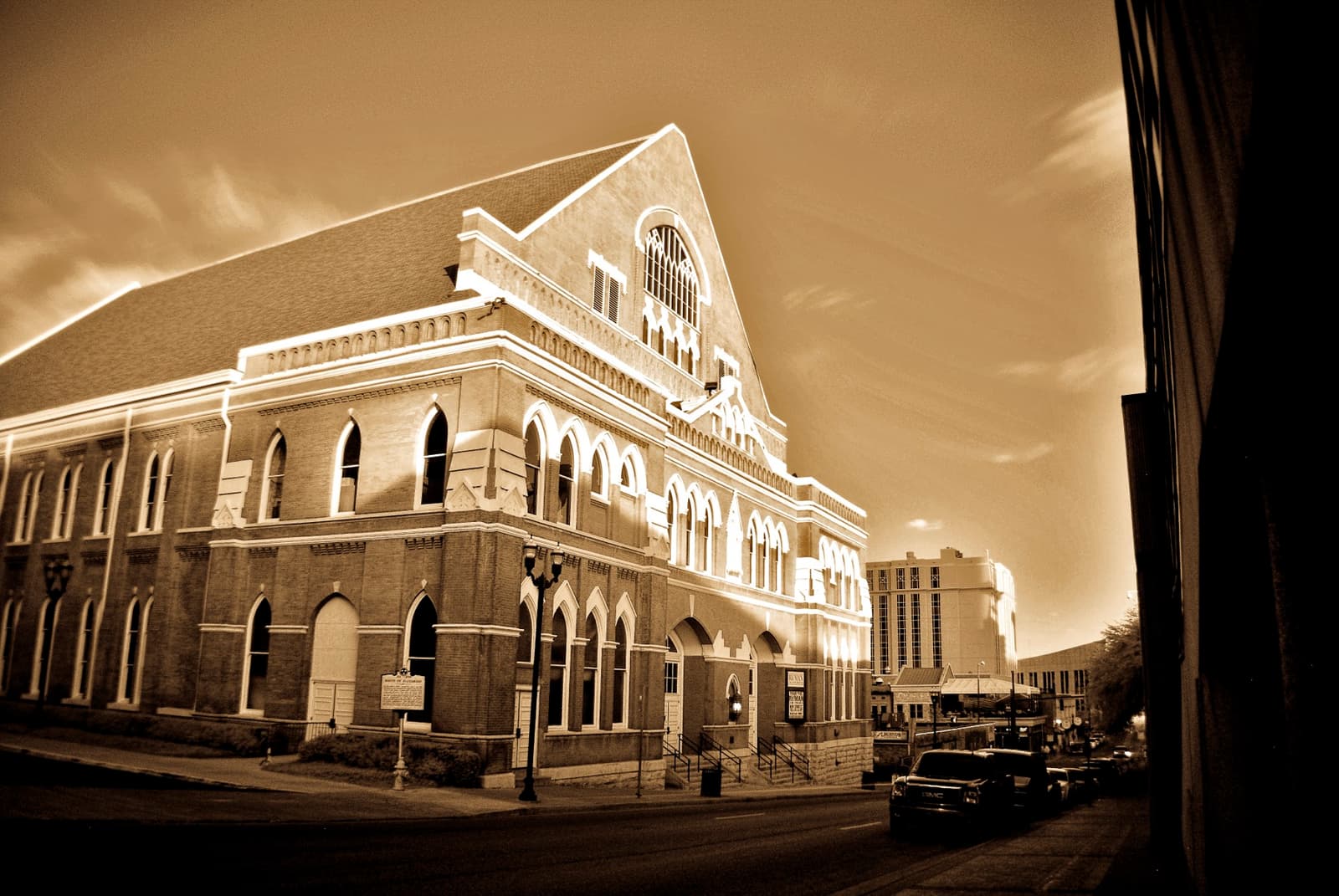
Ryman Auditorium’s own history dates Williams’s Grand Ole Opry debut to 11 June 1949 and recalls six encores of Lovesick Blues. Its account also identifies a custom-tailored suit he wore on the stage, later displayed at the venue. The performance and its material remembrance give the Ryman a different connection from Herzog’s: here the recording hit met the Opry audience. The historical display notice does not establish that the suit remains on view today.[3]
A recording room becomes a place of remembrance
Herzog’s 2019 notice announced a seventieth-anniversary celebration with local performers in the historic studio space. It also described a decade of Cincinnati USA Music Heritage Foundation activity there, including education, rehearsals and new music. The former session setting had become a place where the recording’s history could be passed on through further music-making. The notice establishes the planned celebration and the organisation’s account of its work, without proving that every advertised performance took place.[1]
The Ryman Auditorium, 2010; existing sepia-toned photograph. Isaac777 · CC BY-SA 3.0. Existing local rendition. Venue illustration; not a photograph of the historic music event.
Lovesick Blues at Williams’s Grand Ole Opry debut
11 June 1949
Hank Williams performed Lovesick Blues at his Grand Ole Opry debut at Ryman Auditorium on 11 June 1949; the venue’s history recalls six encores.[3]
Reading the place today
Check current arrangements for the historic Herzog space and Ryman Auditorium. An old anniversary announcement or exhibition notice does not guarantee a present-day event, room visit or object display.