
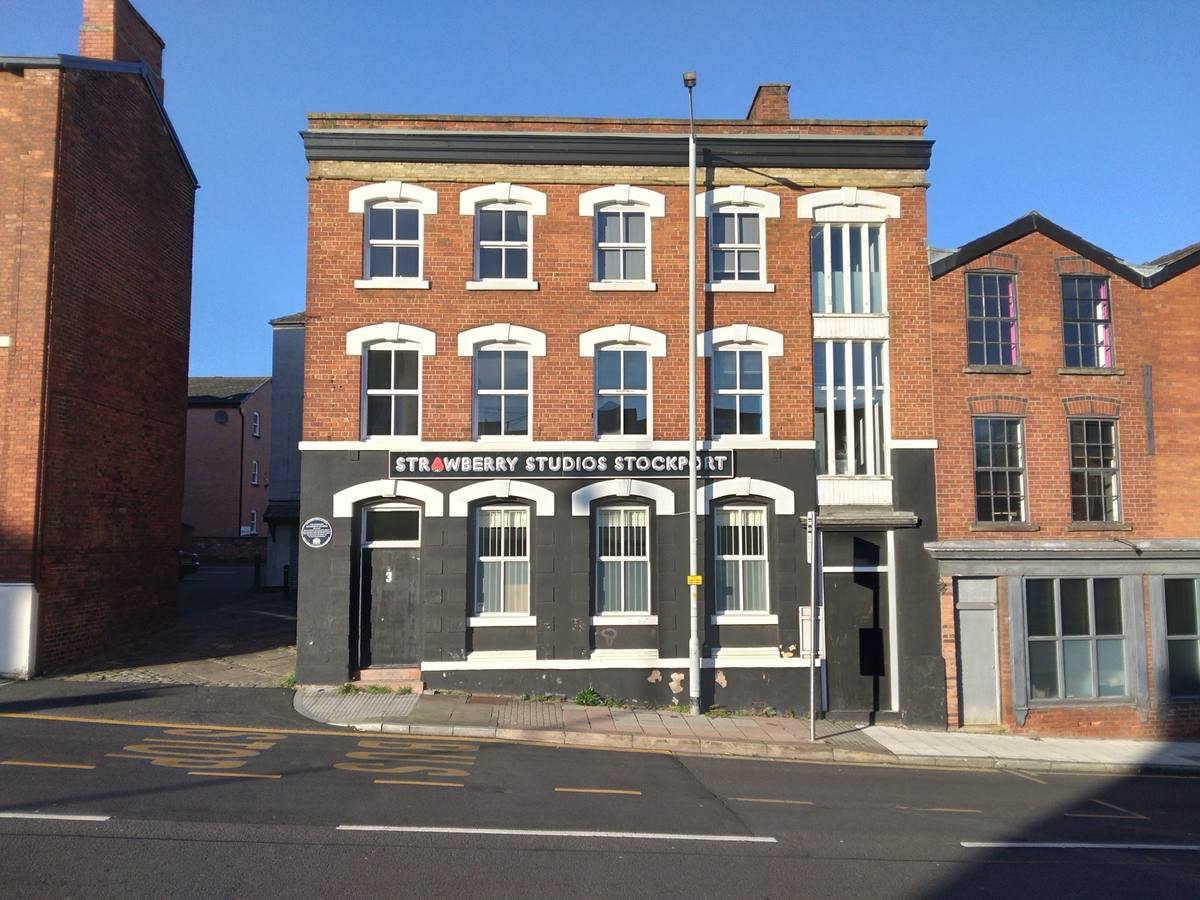
Strawberry Studios
Waterloo Road, Stockport
1979 · album
Strawberry Studios shaped the album’s sound; data from Arecibo lies behind the scientific graphic adapted for its sleeve.
Unknown Pleasures connects two different kinds of recorded signal. Joy Division made the album with Martin Hannett at Strawberry Studios in Stockport. The sleeve’s stacked lines came from a scientific plot based on Arecibo radio observations. Following the recording and the image separately reveals how musicians, a producer, a designer and an astronomer contributed different parts of the album’s identity.
Markers identify buildings or documented location references. They do not mark an exact recording room, stage position or camera angle.
1 place remains listed without a pin.
Stephen Morris’s original GQ interview identifies Strawberry as the recording setting and recalls Hannett noticing the sound of its lift door. The musicians recorded the lift and smashed milk bottles for another sound. Bernard Sumner described using the studio itself as an instrument. Their account makes the working room part of the music’s construction. [3]
LTM’s recording history dates the sessions to April 1979 and preserves the musicians’ differing reactions to Hannett’s production. Sumner recalled a more restrained guitar sound than the band’s heavy live playing; Hook later described the producer giving the music a subtlety they had not initially sought. These recollections are part of the record’s history of reception within the band. They help explain why the studio result could surprise the people who had written and played the songs. [2]
Jen Christiansen’s original investigation traces the sleeve graphic to Harold Craft’s pulsar-data plot. Craft created it from observations collected at the Arecibo Radio Observatory, and it appeared in his September 1970 Cornell thesis. The observatory’s connection is the source data behind an image that later entered music culture. Stockport remains the album’s recording setting. [1]
Christiansen describes visiting Cornell’s rare-book room and finding the plot in Craft’s thesis. Her investigation links that earlier scientific record with the 1977 Cambridge Encyclopaedia of Astronomy and the later album sleeve. The chain is documented through publications and archival research, without an invented band visit to those institutions. [1]
In the GQ oral history, Sumner described the source image as large and black on white, and credited Peter Saville with reducing and reversing it. Saville explained his choice of black as a way of treating the cover as an object. The sleeve’s final presentation was a design decision built around an existing scientific image. [3]
Waterloo Road, Stockport
Historical Arecibo Radio Observatory telescope site, Puerto Rico; data provenance for the sleeve graphic, no performance or exact instrument-position pin
Observations preceding Craft’s September 1970 thesis
Harold Craft’s plot, later adapted for the Unknown Pleasures sleeve, used data collected at Arecibo Radio Observatory. [1]
The studio and observatory connections are historical and do not promise access to recording rooms, telescope structures or surviving equipment.
